DASH Diet Bangla: Your 7-Day Bangladeshi Plan for Lower BP
Posted on Jun 08, 2026
About one in three Bangladeshi adults has high blood pressure. Many don't know it yet. Those who do are often handed a prescription and little else. The medication helps, but it works best alongside a diet that actively supports blood pressure control rather than quietly working against it.
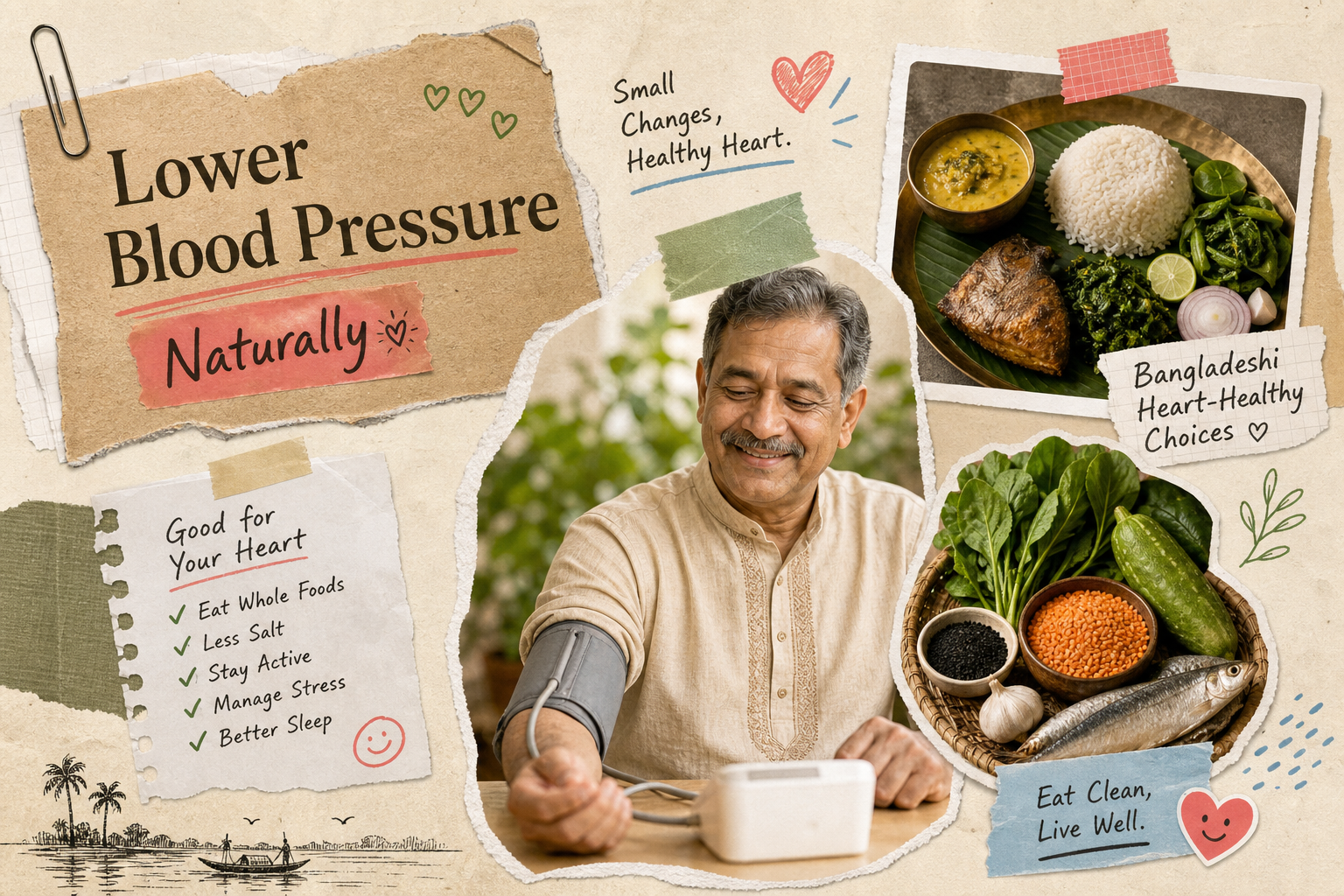
This DASH Diet Bangla guide shows how everyday Bangladeshi foods can lower blood pressure without overhauling your kitchen or your culture. The DASH diet, short for Dietary Approaches to Stop Hypertension, is a clinically validated eating framework developed by the National Heart, Lung, and Blood Institute. It doesn't ask you to eat foreign food or follow a rigid plan designed for someone living in Chicago. It asks you to eat more of what already works and less of what quietly raises your BP. For Bangladeshis, that shift is smaller than most people think.
This guide covers the principles behind the DASH approach, which everyday Bangladeshi foods fit the framework, which ones to pull back on, a practical 7-day meal plan with portions, and how to reduce sodium without losing the flavor of your cooking. For readers managing hypertension alongside diabetes, PCOS, or other conditions, ARACO HealthCare offers certified nutritionist-designed hypertension diet plans in Bangla, accessible from home, without a clinic visit.
What the DASH diet actually is and how it lowers blood pressure
DASH is not a crash diet. It's a long-term eating pattern built around nutrients that directly influence how the body regulates blood pressure: potassium, calcium, magnesium, and fiber. It limits sodium, saturated fat, and added sugar because these push arterial pressure in the wrong direction.
The core framework emphasizes whole grains, vegetables, fruits, low-fat dairy, lean protein (fish, poultry, legumes), nuts and seeds, and minimal sweets. For a 2,000-calorie diet, NHLBI guidelines suggest roughly 6 to 8 servings of grains per day, 4 to 5 servings each of vegetables and fruit, and 2 to 3 servings of low-fat dairy. That structure maps well onto a Bangladeshi plate once portions are adjusted. The food is already here.
The clinical numbers: how much of a reduction to expect
Meta-analyses of randomized controlled trials consistently show DASH reduces systolic blood pressure by around 5 to 7 mmHg and diastolic by 3 to 4 mmHg. When sodium is also reduced, the drops are larger. People starting with higher baseline BP tend to see the biggest improvements, which means early commitment matters most for those already diagnosed.
Bangladeshi adults consume an estimated 9 grams of salt per day, roughly 3,500 mg of sodium. The DASH target is 2,300 mg. That gap explains a lot. Meaningful BP improvement typically appears within 4 to 8 weeks of following the diet consistently, with near-maximal effect by 12 weeks. It's not overnight, but it's faster than most people expect.
DASH Diet Bangla: Bengali foods that already work in your favor
The backbone of a DASH-style eating approach already exists in Bangladeshi cooking. Dal, river fish, seasonal vegetables, fresh fruit, plain yogurt, these are not substitutes or compromises. They are exactly what the evidence supports. The problem with the typical Bangladeshi diet isn't the food itself. It's how much salt, oil, and refined starch gets added during preparation.
Masoor dal and moong dal are naturally low in fat and sodium, high in plant protein, and rich in potassium and magnesium. Seasonal vegetables like shak, gourds, okra, korola, and pui shak provide the fiber and micronutrient density DASH depends on. River fish, rui, katla, hilsa, and small freshwater varieties, are the preferred protein over red meat, and Bangladesh has them in abundance. Fresh guava, papaya, and banana are potassium-rich snacks that fit the framework as naturally as any food from any country. Plain unsweetened yogurt is your DASH-aligned dairy.
How to prepare these foods the DASH way
Preparation matters as much as the ingredient. Grilled, baked, or lightly curried fish instead of deep-fried. Dal cooked with less salt and more vegetables, not heavy with oil. Vegetable curries using minimal oil rather than rich tarkari-style preparations. A smaller portion of white rice paired with more dal and vegetables, or brown rice when available. Atta ruti instead of maida paratha. These aren't radical changes, they're calibrations to dishes you already make. The structure of Bengali cooking is sound. The adjustments are in the ratios and how much salt ends up in the pot.
What to limit or swap in a Bangladeshi kitchen
Some common items in a Bengali diet push sodium, saturated fat, and refined carbohydrates past the DASH threshold. Knowing which ones is the first step. The goal isn't to feel restricted, it's to make smarter choices with the same foods you've always had access to.
The main sodium culprits are pickles (achar), shutki, packaged spice mixes, bottled sauces, papad, chips, and instant or processed foods. These add large amounts of sodium without you realizing it. Deep-fried snacks like singara, samosa, pakora, and jilapi, along with sugary drinks like sweet chai, soft drinks, mishti doi, and condensed milk-based beverages, regularly undermine blood pressure control when consumed daily.
Simple swaps that don't feel like deprivation
Most of these substitutions are straightforward. Try roasted chana instead of fried snacks, fresh fruit instead of sugary desserts, and plain yogurt with a little fruit instead of mishti doi. Cut back on sugar in your tea, or skip it entirely. Fill more of your plate with vegetables and dal, and take a smaller portion of rice.
- Singara or alur chop → roasted chana or a small piece of fresh fruit
- Maida paratha → atta ruti or whole-wheat chapati
- Fried fish → grilled, steamed, or lightly curried fish
- Sweet chai → tea with little or no sugar
- Mishti doi → plain yogurt with fruit or a pinch of spice
You're not eating less. You're eating smarter, and over 12 weeks, that distinction shows up in your blood pressure readings.
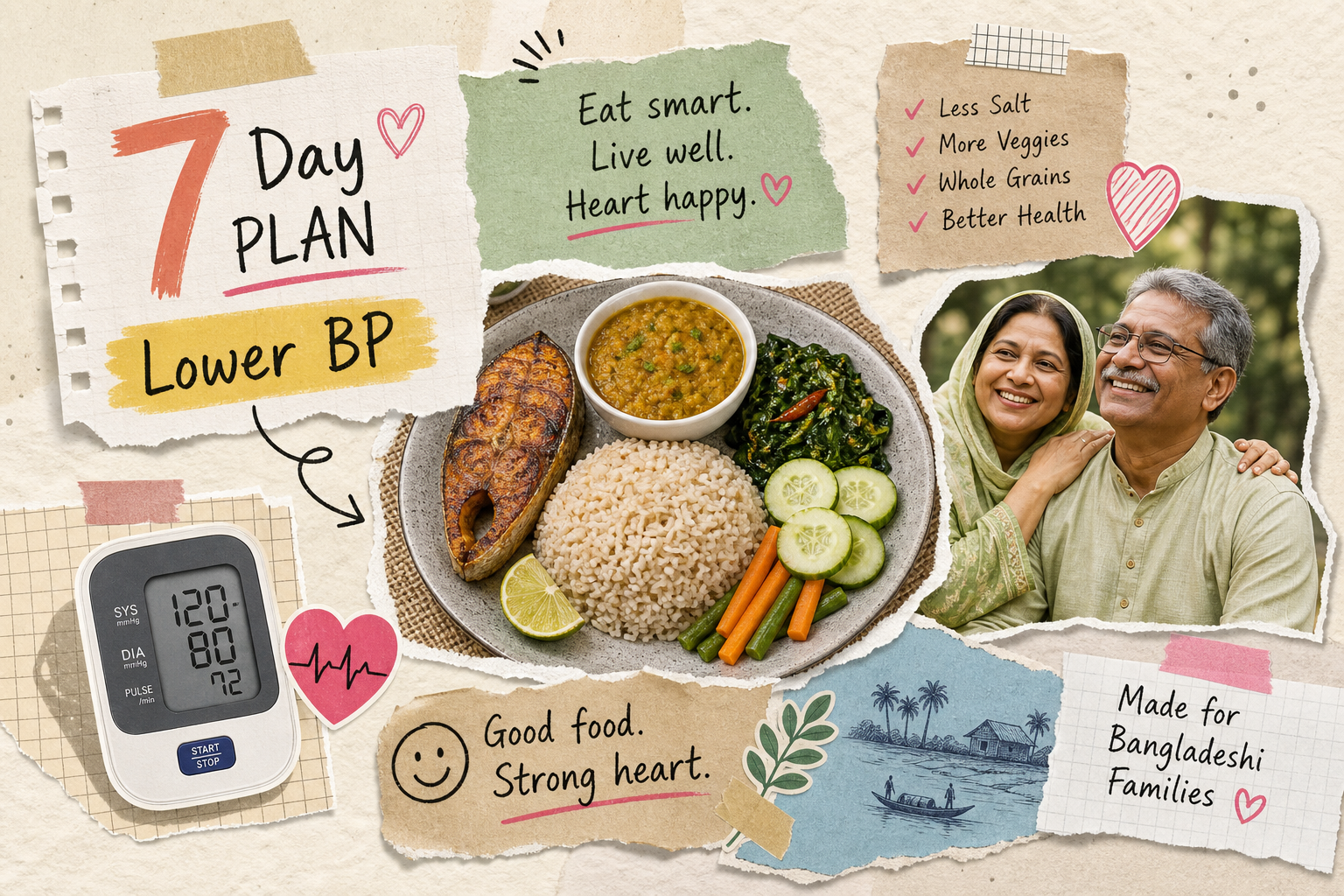
7-Day DASH Diet Bangla meal plan using Bangladeshi dishes
The daily goal is balance across meals, not perfection at every one. Each day below includes breakfast, lunch, dinner, and two snacks. All foods are locally available and affordable. Before looking at the plan, keep this portion model in mind: roughly 1 cup of cooked rice or 2 small atta rotis per meal, about 85g of cooked fish or chicken at dinner, at least 1 cup of vegetables at lunch and dinner, and ¾ cup of dal. Snacks come from fruit, plain yogurt, roasted chana, or unsalted nuts.
| Day | Breakfast | Lunch | Dinner | Snacks |
| Day 1 | 2 moong dal chilla, 1 boiled egg, tea without sugar | 1 cup brown rice, 3 oz grilled fish, 1 cup mixed veg curry, salad | 2 small atta rotis, chicken curry with less oil, 1 cup sautéed spinach | 1 apple; 30g roasted chana |
| Day 2 | 2 slices whole-wheat toast, 2-egg omelet with onion/tomato/spinach, 1 banana | 1 cup rice, ¾ cup masoor dal, 1 cup bhaji, 3 oz fish | 2 rotis, 1 cup lau shak or mixed vegetable tarkari, ½ cup plain yogurt | 1 orange; 6 unsalted almonds |
| Day 3 | 1 cup cooked oats with milk, 1 small banana, 1 tbsp mixed seeds | 2 rotis, ¾ cup chana curry, salad, ½ cup plain yogurt | 1 cup brown rice, 3 oz fish curry, 1 cup shukto or mixed vegetables | 1 guava; 30g roasted makhana |
| Day 4 | 2 vegetable parathas with minimal oil, ½ cup plain yogurt | 1 cup rice, ¾ cup moong dal, 1 cup bhindi/torkari, 3 oz grilled chicken | 2 rotis, 2-egg curry, 1 cup cabbage and carrot stir-fry | 1 pear; 1 cup low-fat milk |
| Day 5 | 2 moong dal chilla, 1 boiled egg, 1 piece fresh fruit | 2 rotis, 3 oz fish bhuna, 1 cup mixed vegetables, salad | 1 cup rice, ¾ cup dal, 1 cup palak bhaji, ½ cup yogurt | 1 cup papaya; 30g unsalted roasted peanuts |
| Day 6 | 1 cup daliya or oats, 1 banana, 1 cup milk | 1 cup rice, 3 oz chicken curry, 1 cup cauliflower and bean torkari, salad | 2 rotis, ½ cup tofu or egg bhurji, 1 cup vegetable curry | 1 apple; 5 walnut halves |
| Day 7 | 2 slices whole-wheat bread, 2 scrambled eggs with spinach, 1 orange | 1 cup brown rice, ¾ cup masoor dal, 3 oz fish, 1 cup lau or korola curry | 2 rotis, 1 cup vegetable stir-fry, ½ cup yogurt | 1 cup fruit salad; 30g roasted chana |
Three principles make this plan stick beyond 7 days. First, rice or roti takes up one-quarter of your plate, and vegetables take up half. Second, include protein at every meal to manage hunger and prevent overeating later. Third, snacks come from whole foods only, not packets. These guidelines work whether you're following this exact plan or building your own meals from what's available.
Cutting sodium without losing the character of Bengali cooking
The worry is understandable: less salt means bland food. But Bengali cooking doesn't rely on salt for its character. It relies on layered spices, aromatics, and souring agents. The salt shaker is actually the last thing you need to reach for, not the first.
Whole spices like cumin, coriander, turmeric, mustard seed, chili, cinnamon, cloves, and bay leaf are all completely sodium-free and form the foundation of Bengali flavor through tempering (phoron). Ginger, garlic, and onion as the aromatic base carry enormous depth before a single grain of salt is added. Lemon juice and tamarind, used in dishes like shorshe mach or dal, add brightness and reduce the need for salt by shifting the flavor profile toward acid. Fresh cilantro and mint added at the end contribute aroma that makes a dish feel finished.
The hidden sodium sources most people overlook
Packaged spice blends, bottled sauces, tomato paste, papad, achar, and shutki are the quiet sodium offenders in a typical Bangladeshi household. A single tablespoon of many bottled sauces can contain 400 to 600 mg of sodium. Achar and shutki, eaten in small amounts as condiments, can push a meal well past the DASH sodium ceiling without the person at the table realizing it.
The practical fix is straightforward: home-cooked food made with whole spices will almost always be lower in sodium than anything from a packet. Limit achar and shutki to occasional use. When using canned beans, rinse them first. Choose low-sodium versions of tomato paste and sauces where available. These small adjustments, stacked together, can meaningfully close the gap between Bangladesh's average sodium intake of around 3,500 mg per day and the DASH target of 2,300 mg.
What to realistically expect and when personalized help makes sense
Blood pressure won't drop in a week. In the first one to two weeks, the body is adjusting to lower sodium and higher potassium. By weeks 4 to 8, measurable reductions are generally observed. By week 12, if the diet is followed consistently, the effect is near its maximum. That timeline is worth holding onto when the early weeks feel slow.
DASH works alongside prescribed medication, not instead of it. If your doctor has given you antihypertensives, continue taking them. Use this eating approach as a complementary tool that makes the medication's job easier over time, not as a reason to stop treatment without medical advice.
Some readers managing hypertension alongside type 2 diabetes, PCOS, kidney concerns, or significant weight issues will find that a general meal plan falls short. These are conditions where nutrient interactions matter and where getting portions and food choices wrong can create new problems. For those readers, ARACO HealthCare provides certified nutritionist-designed hypertension diet plans in Bangla, built specifically around your health profile and accessible entirely from home. No clinic visit required, just a plan tailored to your actual condition and your actual life.
Start with one meal, not the whole diet
The foods that support a locally adapted, DASH-style approach to hypertension management are not foreign or hard to find. Dal, fish, seasonal vegetables, fresh fruit, plain yogurt, they're already in your kitchen. The changes are in the portions, the preparation method, and how much salt ends up in the pot.
You don't need to overhaul everything at once. Start with one meal a day. Swap one snack. Add an extra serving of vegetables to your lunch. Small adjustments made consistently compound over 12 weeks into a meaningful drop in blood pressure. That's what the clinical evidence shows, and it's what people following a thoughtful, locally adapted eating pattern can experience in practice.
Use this DASH Diet Bangla 7-day plan as your starting point. Track how you feel at week 4 and again at week 8. If you need a plan tailored specifically to your health conditions, reach out to a certified nutritionist who can guide you through the process in Bangla. The goal is not perfection. The goal is a blood pressure reading that gives you more years to do what matters.