Keto Diet for Bangladeshis: Can Local Food Make It Work?
Posted on Jun 21, 2026
Can Bangladeshis follow a keto diet with local food? More easily than most people assume, and the answer starts in a kitchen that already has hilsa, eggs, mustard oil, and ghee. Rice isn't just food in Bangladesh. It's the shape of a meal. Without it, most Bangladeshis don't feel like they've eaten at all; they feel like they've had a snack and something went wrong. So when the ketogenic diet shows up and says "no rice, no roti, no dal," the instinct is to scroll past and assume this is a Western diet for people who shop at imported goods stores and have never heard of bhaat.
That instinct is understandable, but it's wrong. Hilsa, eggs, mustard oil, ghee, chicken, and a long list of local vegetables are already sitting in Bangladeshi kitchens and markets. Most of them are nearly perfect keto foods. The ingredients aren't the problem. Clinicians at ARACO HealthCare report that requests for Bangladeshi keto plans have been climbing steadily, and the consistent observation is that the food side is easier than most people expect. The rice side is harder.
This guide covers both sides honestly: what works, what doesn't, what it costs, and when you need clinical guidance before you start.
Can Bangladeshis Follow a Keto Diet with Local Food?
A ketogenic diet keeps net carbohydrates at roughly 20, 25 grams per day. That number sounds manageable until you look at what Bangladeshi staples actually contain. One cup of cooked white rice carries about 45 grams of net carbs, already twice your entire daily allowance on strict keto. A medium whole-wheat roti adds 17, 20 grams. A cup of cooked lentils adds another 18, 20 grams. A medium potato runs 30, 35 grams.
This isn't a portion control problem. It's a structural conflict. The carb load in a standard Bengali lunch (rice, dal, and a small potato dish) can exceed 100 grams of net carbs before the fish or meat even arrives, roughly 45 g from one cup of rice, 19 g from a cup of lentils, and 32 g from a medium potato. No amount of "just cutting back a little" bridges that gap on a strict ketogenic protocol.
The good news is that most of the protein and fat in a Bengali kitchen fits keto perfectly. Fish carries zero net carbs: hilsa, rohu, bhetki, chingri, all of them. A large egg has about 0.5 grams. Chicken and red meat have none. Mustard oil and ghee carry zero carbohydrates and are high in fat, which is precisely what keto requires. The low-carb vegetables common in Bangladesh read like a keto shopping list: cauliflower, cabbage, palong shak, lauki, beans, cucumber, and capsicum all work well.
Bengali cooking has a structural advantage here that most people miss. Keto needs high fat intake, and both mustard oil and ghee are zero-carb, high-fat cooking fats that slot naturally into a ketogenic approach. Bangladeshis already start with them in the pan, no substitutions required.
The Rice Problem: The Hardest Part of Bengali Keto
Let's be honest about this, because pretending it doesn't matter is exactly why many people quit within the first week. Rice is the anchor of Bengali identity at the table. A plate built around fish, vegetables, and mustard oil without bhaat doesn't feel like a meal to most Bangladeshis. It feels like something is missing, and that feeling is real, not just a matter of willpower.
The most practical substitute is cauliflower rice: finely grated cauliflower, dry-roasted or lightly sautéed in mustard oil until it softens and separates. A cup of cauliflower rice has about 3 grams of net carbs compared to 44, 45 grams in cooked white rice. That's a meaningful difference. Shredded cabbage stir-fried in mustard oil also works as a base for curries. Neither tastes like bhaat, and that's worth saying plainly. What stays intact is everything else: the jhol, the mustard paste, the turmeric, the green chili. The Bengali cooking identity doesn't change. The carb vehicle does. These Bengali low-carb recipes keep the spices and techniques entirely intact.
One more thing worth naming: "just a little rice" doesn't really work on strict keto. Three to four tablespoons of cooked rice contribute roughly 8, 11 grams of net carbs, leaving very little room for vegetables, lentils, or anything else across the rest of the day. If your goal is a modest low-carb approach, say, 50, 80 grams of net carbs per day, a very small rice portion might fit. But that is low-carb eating, not ketogenic. Both are valid, but they're different things, and being clear about that distinction matters when setting expectations.
A Bangladeshi Keto Meal Plan Built from Local Ingredients
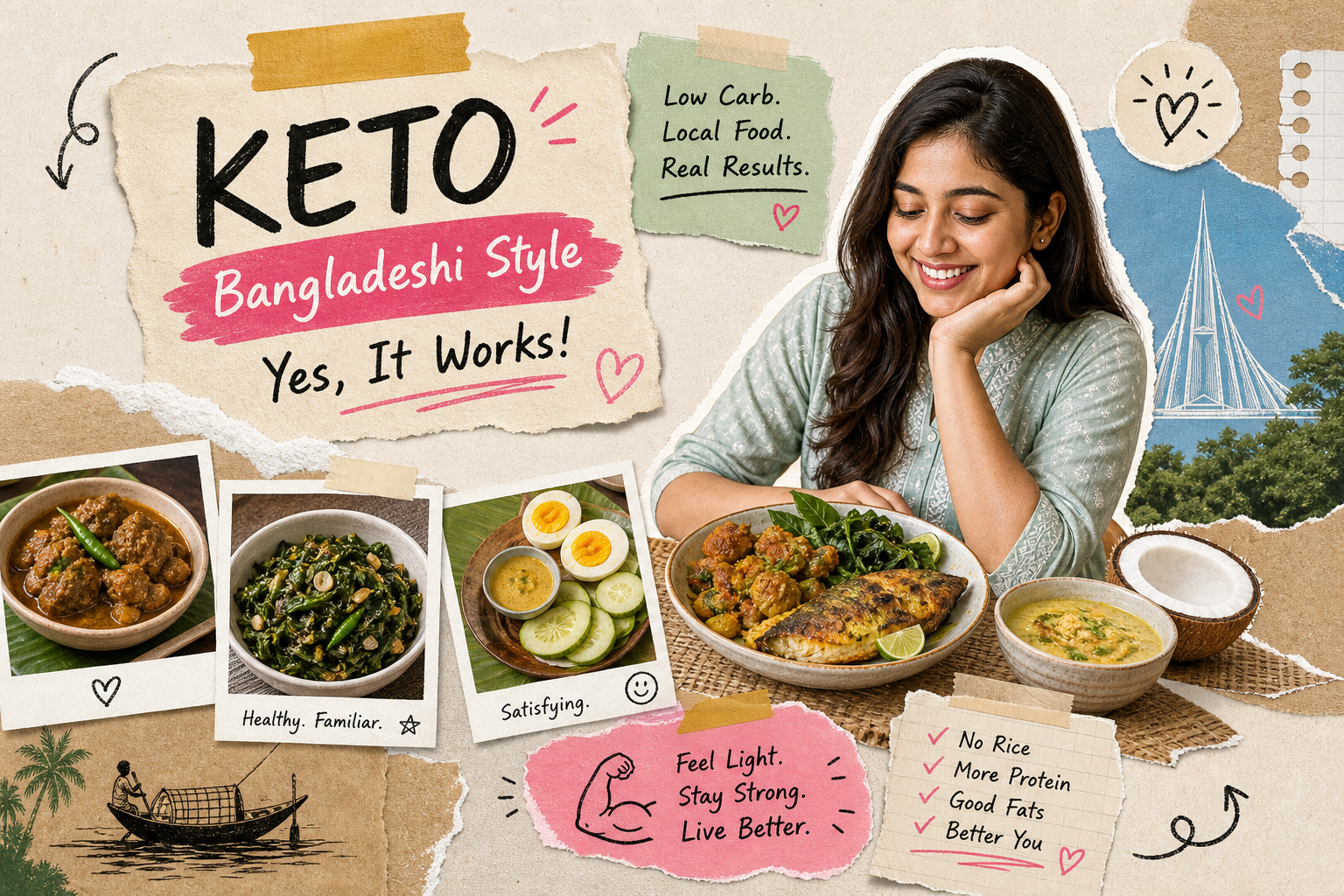
Following a keto diet with local food in Bangladesh is more practical than it sounds on paper. A typical keto day in a Bengali kitchen looks like this: an egg-heavy breakfast cooked in ghee, fish or meat with cauliflower rice at lunch, a vegetable stir-fry with chicken or mutton at dinner, and snacks built from boiled eggs, roasted peanuts, cucumber with salt, or coconut pieces. The spices stay entirely Bengali, mustard, turmeric, cumin, green chili, ginger, garlic, coriander. What shifts is structural, not cultural.
Here's a sample week built from ingredients available in any local বাজার:
| Day | Breakfast | Lunch | Dinner |
| Monday | Dim bhurji in ghee with green chili and coriander | Shorshe machh with cauliflower rice and sautéed spinach | Chicken kosha with cabbage stir-fry |
| Tuesday | Masala omelette with spinach | Chingri malai cooked in coconut milk with sautéed cabbage | Mutton curry with cauliflower mash |
| Wednesday | Boiled eggs with mustard dip | Fish fry in mustard oil with cucumber salad | Palong shak with egg curry |
| Thursday | Egg scramble with tomato, onion, and ghee | Chicken jhol with bottle gourd and extra mustard oil | Cauliflower rice with grilled chicken and greens |
| Friday | Cheese omelette with sautéed mushrooms | Prawn stir-fry with cabbage and garlic | Egg curry with cauliflower bhaat |
| Saturday | Dim bhurji with green chili | Bhetki curry with cauliflower rice | Kosha mangsho with sautéed greens |
| Sunday | Egg cutlets pan-fried in ghee | Ilish curry with cauliflower rice | Grilled chicken with lauki and mustard oil |
Snack through the week with boiled eggs, a small handful of roasted peanuts, cucumber slices, or unsweetened yogurt in modest portions. Keep onions and tomatoes to small amounts, they add carbs faster than most people realize (a medium onion carries around 10 grams of net carbs, and a medium tomato adds another 4, 5 grams).
Keto on a Budget in Bangladesh
A standard balanced diet in Bangladesh costs roughly 70, 130 BDT per day. A practical keto day runs closer to 110, 220 BDT, because you're replacing cheap lentil and rice calories with eggs, fish, and meat. That premium is real, and it's worth acknowledging rather than glossing over. Keto on a budget in Bangladesh is still achievable, it just requires a few deliberate ingredient swaps.
Most expensive keto ingredients have affordable local substitutes:
- Almond flour (imported, expensive): use egg-based batters or cauliflower as a cooking base instead.
- Mixed imported nuts: replace with peanuts, flax seeds, and chia seeds, cheaper and widely available.
- Avocado: use cucumber, cabbage, or capsicum for snacks and salads.
- Coconut oil: ghee and mustard oil are locally produced, cheaper, and equally keto-compatible.
The most cost-effective anchor of Bengali keto is eggs. Broiler eggs currently run about 135, 145 BDT per dozen in Dhaka retail markets. A day built around four to six eggs, one serving of fish or chicken, and seasonal vegetables from the local bazaar keeps the cost closer to the lower end of the range. Buying from neighborhood markets rather than supermarkets cuts costs further. Hilsa is genuinely expensive at 1,400, 2,300 BDT per kg for medium to large sizes, but rohu, bhetki, and chingri are more affordable and equally keto-friendly. Broiler chicken at 170, 200 BDT per kg is the most economical animal protein for frequent use.
Health Risks and Who Should Not Try Keto
Keto Flu and the South Asian Adjustment Period
Most people transitioning from a high-carb Bangladeshi diet to keto will experience what's called keto flu in the first one to two weeks. The common symptoms are headache, fatigue, brain fog, nausea, dizziness, and digestive discomfort. Ketosis typically begins within two to four days, but for someone coming from a heavily rice-based diet, full metabolic stabilization can take a week or longer. This is temporary, but it's uncomfortable. Staying well-hydrated, adding electrolytes (a pinch of salt in water works), and eating enough fat through the transition reduces the severity.
Medical Conditions That Require Clinical Clearance
Certain medical conditions make keto genuinely risky and require clinical clearance before starting. These include fatty acid oxidation disorders, pancreatitis, severe liver disease, marked dyslipidemia, significant cardiovascular risk, a history of kidney stones, and any condition involving malnutrition or micronutrient deficiency. People managing type 1 diabetes, chronic kidney disease, or those on specific medications should not start a ketogenic diet without direct medical guidance.
For South Asian populations specifically, the shift from a very high-carb dietary baseline is more abrupt than it is for most Western populations. The metabolic adjustment is more dramatic, and the risk of unsupervised errors is higher. This isn't bureaucratic caution, it reflects genuine physiological differences in the starting point. An ILAE workshop on ketogenic therapy for South Asia placed medical monitoring at the center of every recommendation, not as a formality, but as a substantive keto safety measure for Bangladesh and the broader region.
How to Start Keto Safely in Bangladesh
Most keto guides available online were written for someone eating avocado toast and bacon in a California kitchen. Applying those templates to a Bangladeshi lifestyle creates friction at every meal, and that friction compounds into abandonment within a few weeks. A Bangladeshi keto meal plan that already maps macros onto shorshe machh, chingri malai, and cauliflower bhaat removes the guesswork and keeps the cooking identity intact.
A certified nutritionist familiar with Bangladeshi food habits can adjust your macros for your specific health condition, activity level, food preferences, and budget. This matters especially if you're managing diabetes, PCOS, hypertension, or any other chronic condition where dietary changes interact with medication or lab values. ARACO HealthCare offers certified nutritionist-designed keto plans built specifically around Bangladeshi ingredients and cooking methods, not imported substitutes. For anyone with an underlying condition, or anyone who has tried generic keto plans and found them unworkable, starting through a platform like ARACO HealthCare is a more sustainable path than a cold-turkey diet switch with no monitoring.
The Answer Is Yes, With Honest Expectations
So, can Bangladeshis follow a keto diet with local food? Yes, and the ingredients to do it are already in most kitchens. Hilsa, eggs, mustard oil, ghee, cauliflower, cabbage, chicken, and mutton are all keto-compatible. The spices and cooking methods that define Bengali cuisine stay completely intact. What changes is the carb vehicle, and cauliflower rice is the most practical substitute available.
The cultural challenge around rice is real. Budget is a legitimate constraint. And for certain health conditions, unsupervised keto carries genuine risks. All three are solvable problems, not reasons to dismiss the approach entirely.
Following a keto diet with local food in Bangladesh is more practical than most people assume. The ingredients were always there. What's usually missing is a plan built for your kitchen, your budget, and your health, not someone else's.