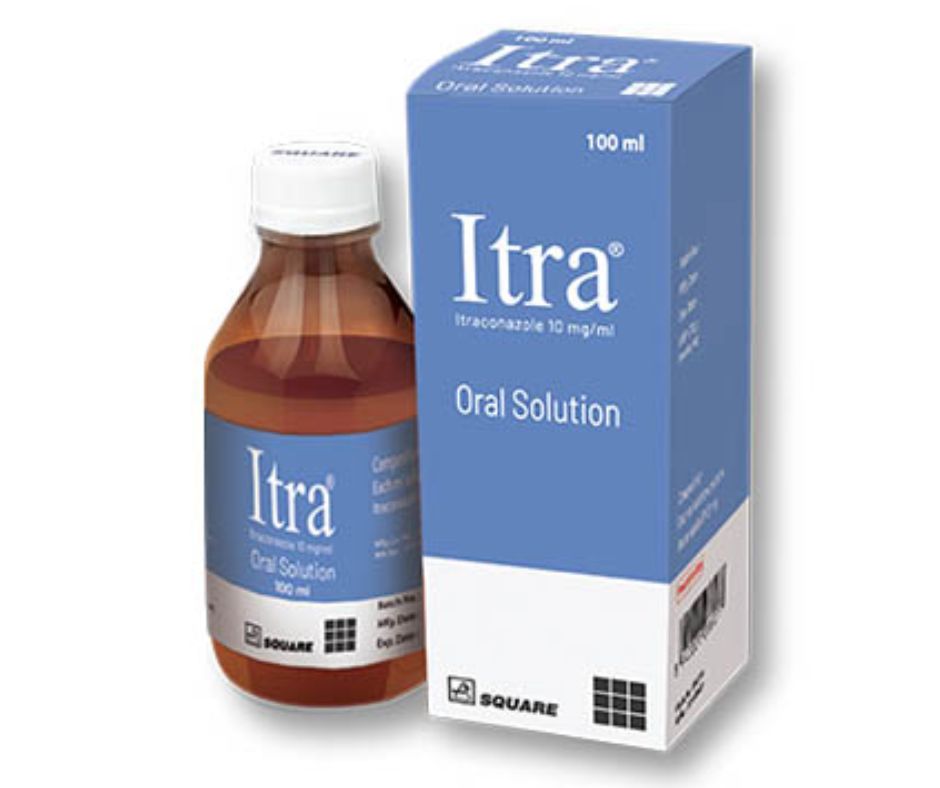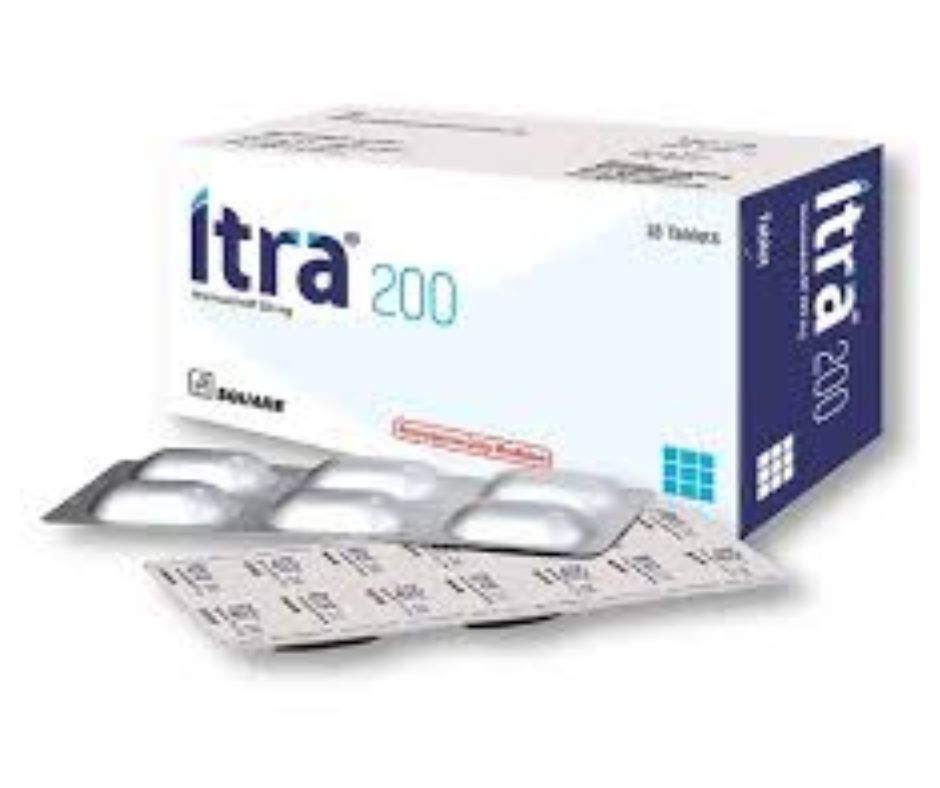
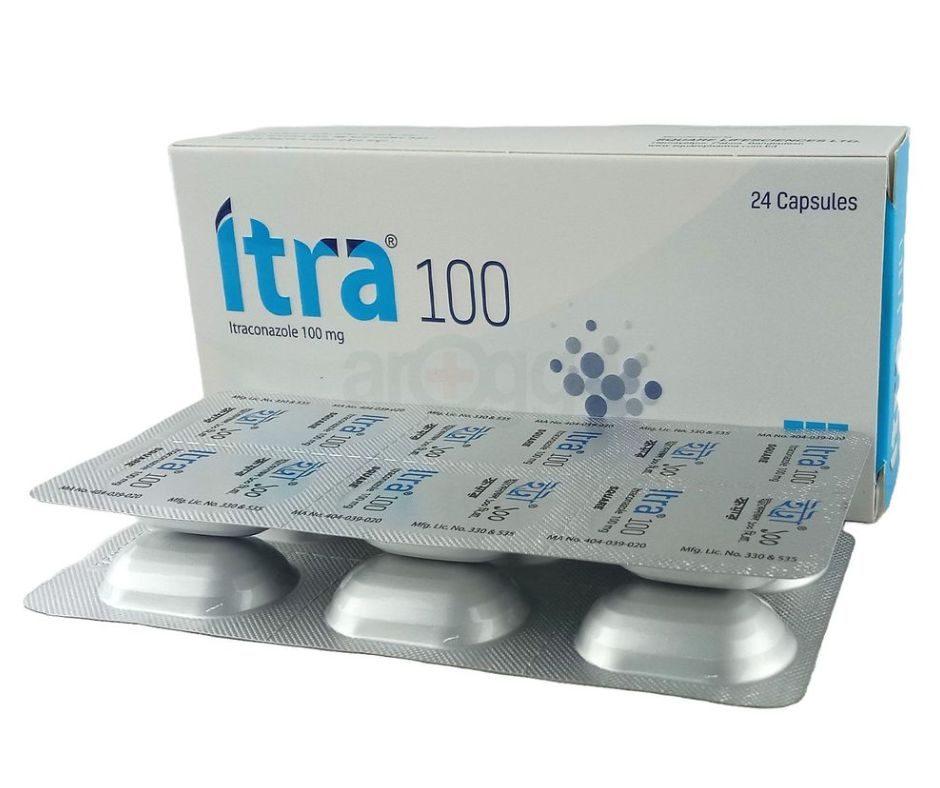
Itra 100mg
৳326.16
৳362.40
Save 10.00%
In Stock (100 available)
Sub Total: ৳326.16
Overview
Indications Itra is used for the treatment of oropharyngeal candidiasis, vulvovaginal candidiasis, pityriasis versicolor, tinea pedis, tinea cruris, tinea corporis, tinea manuum, onychomycosis, histoplasmosis. It is indicated in the treatment of systemic candidiasis, aspergillosis, and cryptococcosis (including ... Read more * রেজিস্টার্ড চিকিৎসকের পরামর্শ মোতাবেক ঔষধ সেবন করুন' Pharmacology Itr… ... See More Indications Itra is used for the treatment of oropharyngeal candidiasis, vulvovaginal candidiasis, pityriasis versicolor, tinea pedis, tinea cruris, tinea corporis, tinea manuum, onychomycosis, histoplasmosis. It is indicated in the treatment of systemic candidiasis, aspergillosis, and cryptococcosis (including ... Read more * রেজিস্টার্ড চিকিৎসকের পরামর্শ মোতাবেক ঔষধ সেবন করুন' Pharmacology Itraconazole inhibits Cytochrome P-450 dependent enzymes resulting in impairment of the biosynthesis of ergosterol, a major component of the cell membrane of yeast and fungal cells. Being integral to the proper functioning of the cell membrane, inhibition of the synthesis of ergosterol leads to a cascade of abnormalities in permeability, membrane bound enzyme activity, and co-ordination of chitin synthesis leading to inhibition of growth, abnormal cell wall formation and accumulation of intracellular lipids and membranous vesicles. SUBA (Super Bio-available) technology is a novel technology for enhancing the bioavailability of poorly soluble drugs. This technology utilizes a solid dispersion of drug in a polymer that improves the dissolution of poorly soluble drugs compared to their normal crystalline form. SUBA technology Itraconazole is an orally active triazole antifungal drug that has demonstrated a broad spectrum of activity and favorable pharmacokinetic profile. Dosage & Administration 100 & 200 mg preparation: For non-systemic fungal disease- Vulvovaginal candidiasis: 200 mg twice daily for 01 day Pityriasis versicolor: 200 mg once daily for 07 days Tinea corporis, tinea cruris: 100 mg once daily for 15 days or 200 mg once daily for 7 days Tinea pedis, tinea manuum: 100 mg once daily for 30 days Oropharyngeal candidiasis: 100 mg once daily for 15 days, Increase dose to 200 mg once daily for 15 days in AIDS or neutropenic patients because of impaired absorption in these groups. Onychomycosis (toenails with or without fingernail involvement): Either 200 mg daily for 3 months or course (pulse) of 200 mg twice daily for 7 days, subsequent courses repeated after 21 days' interval. Fingernails two courses, toenails three courses. For systemic fungal disease- Aspergillosis: 200 mg once daily for 2-5 months Increase dose to 200 mg twice daily in case of invasive or disseminated disease Candidiasis: 100-200 mg once daily for 3 weeks-7 months. Increase dose to 200 mg twice daily in case of invasive or disseminated disease Non-meningeal Cryptococcosis: 200 mg once daily for 10 weeks Cryptococcal meningitis: 200 mg twice daily for 2-6 months Histoplasmosis: 200 mg once daily twice daily for 8 months Maintenance in AIDS: 200 mg once daily until immune recovery Prophylaxis in neutropenia: 200 mg once daily until immune recovery The dose and duration of treatment for systemic antifungal disease should be adjusted depending on the clinical response. 65 mg & 130 mg preparation: For non-systemic fungal disease- Vulvovaginal candidiasis: 130 mg twice daily for 1 day Pityriasis versicolor: 65 mg twice daily for 7 days Tinea corporis and tinea cruris: 65 mg daily for 15 days OR 65 mg twice daily for 7 days Tinea pedis and tinea manuum: 65 mg once daily for 30 days Oropharyngeal Candidiasis: 65 mg once daily for 15 days, increase dose to 65 mg twice daily for 15 days in AIDS or neutropenic patients because of impaired absorption in these groups. Onychomycosis (toenails with or without fingernail involvement): Either 65 mg twice daily for 3 months or course (pulse) of 130 mg twice daily for 7 days, subsequent courses repeated after 21 days interval. Fingernails two courses, toenails three courses. For systemic fungal disease- Aspergillosis: 65 mg twice daily for 2-5 months.Increase dose to 130 mg twice daily in case of invasive or disseminated disease Candidiasis: 65-130 mg once daily for 3 weeks-7 months. Increase dose to 65 mg twice daily in case of invasive or disseminated disease Non-meningeal Cryptococcosis: 65 mg twice daily for 10 weeks Cryptococcal meningitis: 130 mg twice daily for 2-6 months Histoplasmosis: 130 mg once daily-twice daily for 8 months Maintenance in AIDS: 65 mg twice daily until immune recovery Prophylaxis in neutropenia: 65 mg twice daily until immune recovery The dose and duration of treatment for systemic anti-fungal disease should be adjusted depending on the clinical response. pediatric use: The efficacy and safety of the Itraconazole capsule have not been established in pediatric patients. * রেজিস্টার্ড চিকিৎসকের পরামর্শ মোতাবেক ঔষধ সেবন করুন' Interaction The drugs like terfenadine, astemizole, cisapride, HMG-CoA reductase inhibitors such as simvastatin, oral midazolam or triazolam should not be given concurrently with Itra. Significant interactions also observed during co-administration of rifampin, phenytoin, phenobarbital, digoxin, and calcium channel blockers. There is no experience of overdosage with Itra. Contraindications Itraconazole is contraindicated in patients with known hypersensitivity to the drug or any ingredient in the formulation. Patients who have severe hepatic disease are not advised to take Itraconazole. It is not advisable to use the drug in patients taking rifampin, which appears to initially inhibit and then enhance the metabolism of Itraconazole. Side Effects Nausea, abdominal pain, dyspepsia, constipation, headache, dizziness, raised liver enzymes, menstrual disorders, allergic reactions (including pruritus, rash, urticaria and angioedema), hepatitis and cholestatic jaundice, peripheral neuropathy and Stevens-Johnson syndrome reported. On prolonged use hypokalaemia, oedema and hair loss reported. Pregnancy & Lactation Itraconazole is contraindicated in pregnancy. Breast feeding while receiving Itraconazole is not recommended. Precautions & Warnings Absorption is impaired when gastric acidity is reduced. In patients receiving acid neutralizing medicines (e.g. aluminium hydroxide), these should be administered at least 2 hours after the intake of Itra. The drug should be administered after a full meal. Rarely, cases of hepatitis and jaundice have been reported mainly in patients treated for longer than one month. It is therefore, advised to monitor liver function in patients receiving continuous treatment of more than one month. Therapeutic Class Drugs for subcutaneous and mycoses Storage Conditions Store below 25°C, in a cool & dry place. Keep away from light. Keep all the medicine out of the reach of children. See Less